Feeding bees seems to be a somewhat controversial topic amongst beekeepers. Some will tell you to feed, others will be dead set against the idea.
After all, It is generally accepted European Honeybees (apis Melliferra) evolved some 6 to 9 million years ago. The notion is they should know what they are doing, right?
Not quite. Let me explain.
Honeybees are classified as a super organisim, which evolved to build honeycomb and fill with stores of honey for their exclusive use at a later date. These stores would ensure the colonies survival in a lean season, and still have enough honey in reserve for over wintering to see the (hopefully bountiful) new season.
In contrast, we modern humans (homo sapien) appeared a mere 200,000 – 300,000 years ago, with the first brave person deciding on becoming a beekeeper around 9,000 years when a likely swarm of bees took up residence in a woven basket.
The keeping of bees by humans for the sole purpose of pilfering their honey is not what the bees had in mind when we humans pursued this form of Agriculture.
It is also important to consider the European honeybee, and the various associated races within this species has evolved over 9 million years to not only to live, but thrive in its original habitat taking full advantage of the native floral sources within Europe.
Some 200 years ago the same bees were imported into Australia, where they have had to learn to adapt, rather than evolve.
More recently the human notion of selectively breeding and hybridising for increased commercial honey production has increased yields, but it is important not to loose sight that honeybees still produce honey for themselves, not us.
In a commercial apiculture operation sense, honey is money. Hives are moved from location to location, seeking to capture different honey flows from different flowering sources at different times. The aim of the game is to extract the honey, and return the empty frames to have the bees fill them again as quickly as possible to ensure a sufficient yield and remain financially profitable.
At the end of the season there is little or no honey stored within these migratory hives as it has all been extracted.
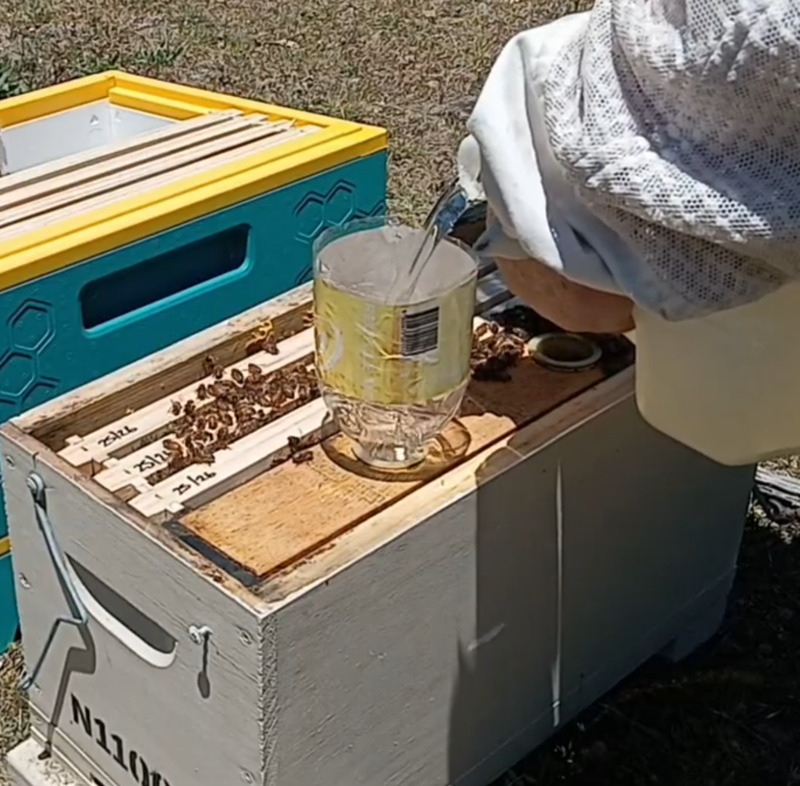
The beekeeper will then begin to fed them with a syrup formulated with white sugar to simulate a final flow, as it is much cheaper than leaving honey on the hive.
The bees then process and store the provided sugar syrup as food for their over wintering needs, only to require another feed in late winter or early spring to encourage build up for the upcoming season where the process starts again.
Unlike the commercial beekeeper, the hobbyist or backyard beekeeper is not likely to migrate hives, and is reliant on the immediate environment to sustain their honey bees.
For the most part, commercially bred queens are used by the hobbyist. These bees are bred for honey production and may, or may not perform the way we would like in your environment with limited flows, and limited local adaptation.
In these cases, you may very well find yourself supplement feeding your unproductive, unsuited bees until a better queen becomes available, or local adaptation occurs.
You may also find yourself and your otherwise well performing bees in the middle of a nectar flow shortage. This situation is known by beekeepers as a ‘Dearth’ or Dead Earth.
In this case, the limited resources available vs the colonies requirements might be unsustainable during these periods, and human intervention by feeding may be required.
The pursuit of beekeeping for honey production in either a commercial or hobby sense is about the manipulation of an otherwise natural process.
When we manipulate our bees place our bees in a man made hive and expect them to perform, you start to realise this is no different any other form of agricultural process which involves imported managed livestock.
Cattle and sheep will also require supplementary feeding to avoid starvation, maintain health and quality of life. Any need to feed your bees, particularly to benefit their well-being should be viewed in the same context, after all honeybees are livestock.
Last Update 22 Apr 2026