
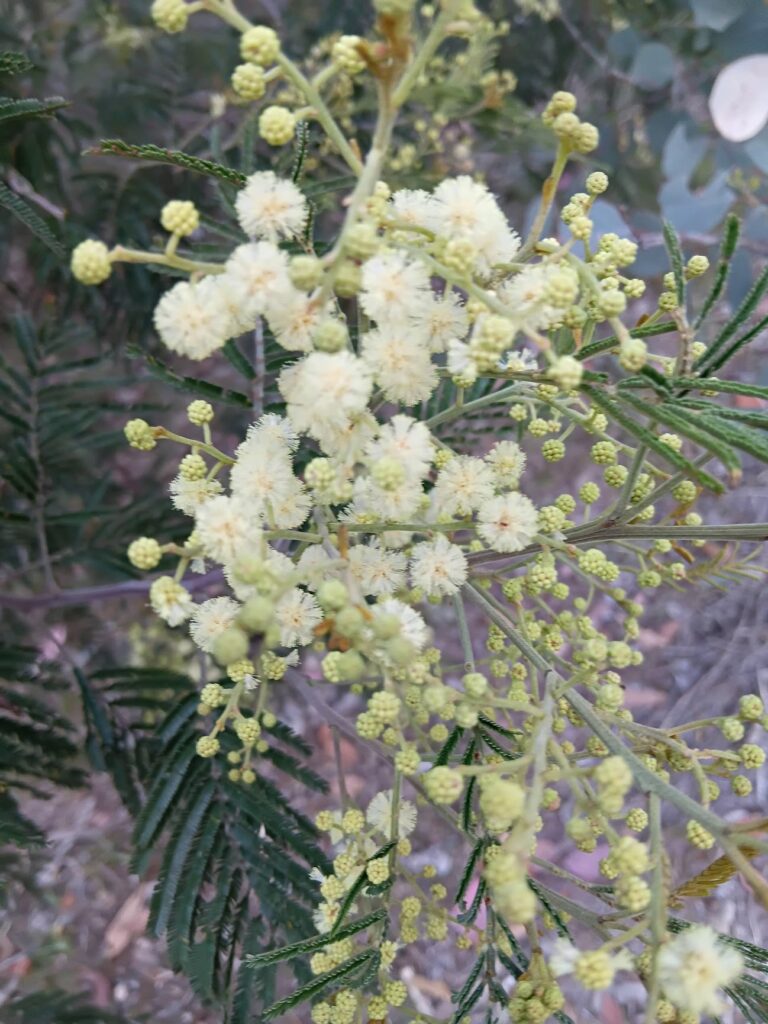
Wattles are among the earliest pollen-bearing resources available to honeybees within the Canberra and Southern NSW regions.
These species of native Acacia are found in high abundance across Canberra’s nature reserves, urban landscapes and rural fringes.
At last count there were around two dozen Acacia species native to the ACT and immediate surrounds and approximately a dozen more which have become naturalised. I will limit the discussion to the most common species that are found widely throughout the region and are of the greatest interest to us as beekeepers.
The status of the wattle as Australia’s national floral emblem has led to many non-local species such as the golden wattle being planted in suburban gardens. Their proximity to local varieties has also resulted in the proliferation of natural hybrids throughout the capital.
Wattles however do not produce a honey harvest, yet they serve as a critical biological trigger for honeybees. The influx of pollen shifts a colony’s instinct from winter survival to spring colony expansion.
Whilst most wattle pollen is generally high in crude protein (often 20–25%), providing many of the essential nutrients nurse bees require to produce royal jelly and initiate the brooding process, honeybees cannot raise larvae on pollen alone.
An abundance of wattle pollen also creates a high-risk period for the colony, and whilst hardwired to react to increasing pollen stores, the bees are essentially “tricked” into expecting a simultaneous abundance of nectar, all except for one point. Apis mellifera (the European honeybee) evolved alongside varied European flora, not wattle.
Almost all species of Australian Acacia, including wattles feature extra-floral nectaries (small glands on the leaf stalks) rather than nectar-rich flowers, and although these glands do produce trace amounts of sugary nectar to attract protective ants, it does not provide enough nectar for honeybees to store.
Tricked, the queen begins to lay thousands of eggs in response to the pollen influx, the colony quickly consumes its remaining winter honey stores to fuel this growth, only to realise they have hit a “false spring” typical of the ACT and Southern NSW.
This results in many colonies starving to death during late August and September due to depleted stores and a lack of incoming nectar, and this is where beekeepers play their part by feeding managed honeybee colonies with a 1:1 sugar syrup to simulate a spring nectar flow that is otherwise absent.
In general a beekeeper should also monitor pollen bags of returning forager bees landing back to the hive’s entrance. Optimally three types of pollen coming in is ideal for brood rearing, however with wattle being the sole providing species, one could be forgiven into believing it to be nutritionally the same, but they are not.
In our cooler climate, you will likely see a progression of different wattle species, some will be the ‘steak and three veg’ and others will be the ‘cheeseburger and chips’. Both will keep you alive, but one is nutritionally superior.
Local beekeepers should also be mindful that If winds and a false spring inhibits foraging ability at the time the ‘steak and three veg’ are on offer, then you may need to consider supplemental feeding of irradiated pollen, pollen substitute (soy flour and minerals), or pollen patties.
Additionally, you could also consider adding a commercially available mineral feed to sugar syrup which is a good idea anyway as Australia lacks some minerals which honeybees would otherwise have access to in Europe.
As touched on earlier, many non local wattles have been planted in suburban Canberra gardens and in close proximity to local species which have resulted in hybrid species becoming very common in urban areas.
One such example is the Cootamundra / Black Wattle cross. This is a frequently spotted hybrid in ACT and Southern NSW. You’ll see a tree that looks like a Cootamundra wattle but with greener, slightly longer leaves.
These hybrids can actually be a benefit to us beekeepers because they often have staggered flowering times.
A hybrid might start blooming a week after the Cootamundra but a week before the Silver Wattle, effectively creating an overlap and providing a more consistent supply for the brood nest, however do consider these hybrids might not always be prevalent in rural areas.
Although most wattle species found in the ACT and region meet the 20% crude protein requirements for honeybees, wattles can be deficient in lipids which are a broad group of naturally occurring molecules that include fats, waxes, sterols, and fat-soluble vitamins which are equally important for honeybee nutrition.
Honeybees require a specific balance of nutrients to sustain a healthy colony, and while protein builds the tissue bulk in larval development, lipids are responsible for building the immune system and hormone regulation. The two are critical for producing healthy bees.
This means beekeepers with bees foraging on wattle for spring build up need to keep a close eye on the types and volume of pollen their bees are bringing into the hive.
If the wattle bloom is heavy but the wind is howling (a standard Canberra spring), the bees won’t be able to forage effectively. On these days, the colony will be bunkered down inside their hive with a massive brood nest to feed. If you have three days of bad weather during a
wattle bloom, it is worth checking their stores and react accordingly.
Happy beekeeping.