
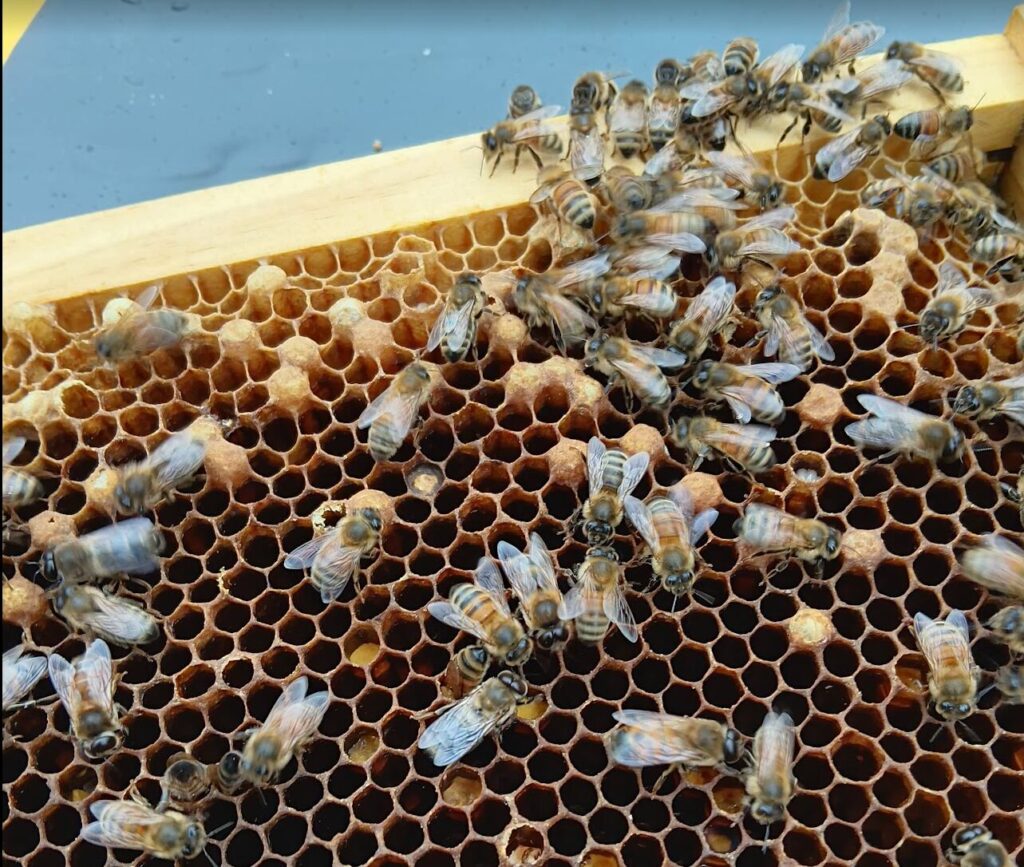
Perhaps like me you made a few splits and used self-raised queens this 2025 – 2026 season.
Maybe you to have noticed your newly mated self-raised queens failing prematurely and turning into drone layers? I suspect it’s a direct symptom of a dwindling local bee population, and this has been noted everywhere else when Varroa moved in.
With the recent arrival of Varroa Destructor in Canberra, it doesn’t just mean we just have to start counting and treating mites accordingly, it also means we have to rethink how we manage honeybee genetics now the mite has begun to firmly established itself within the region.
The days of letting a hive ‘figure it out on its own’ by dropping in a swarm cell, or frame of eggs and brood from another hive to allow the bees to self raise a queen, and then hopefully she goes off and mate with local drones appear to be drawing to a close – (for now).
To understand why our queens are failing, we have to look at how they mate.
In the past, Canberra’s unique ‘Bush Capital’ landscape was a paradise for feral honeybee colonies. From the expansive nature reserves and our suburban laden hollowed-out eucalyptus trees to the gaps in old suburban red brickwork, these feral colonies thrived almost anywhere they could find a foothold. This widespread wild honeybee population guaranteed that our local DCAs were always flooded with robust and genetically diverse healthy drones.
Even if your backyard apiary only had a couple of hives, the surrounding bushland ensured your virgin queen was spoiled for choice when it came do mating.
The virgin queen would fly to the local DCA mid late afternoon where she would mate with anywhere from 12 to 20+ drones to fully load her spermatheca (sperm storage organ) for a long, productive life. This was easily achievable in Canberra when the timing was right.
With Varroa now firmly planted in our region, those unmanaged feral colonies are some of the first to succumb with colony losses to be estimated at around 95%, these wild hives crash quickly as they lack the beekeeper intervention of managed hives.
This creates a massive vacuum as the sheer number of available drones has simply plummeted, leading to a half mated or poorly mated queen returning to head up the colony.
Your returned queen might initially start laying beautiful worker brood, however if she only mated with perhaps 5 or 6 drones instead of say the usual 15 to 20+, then this will be a real problem down the track.
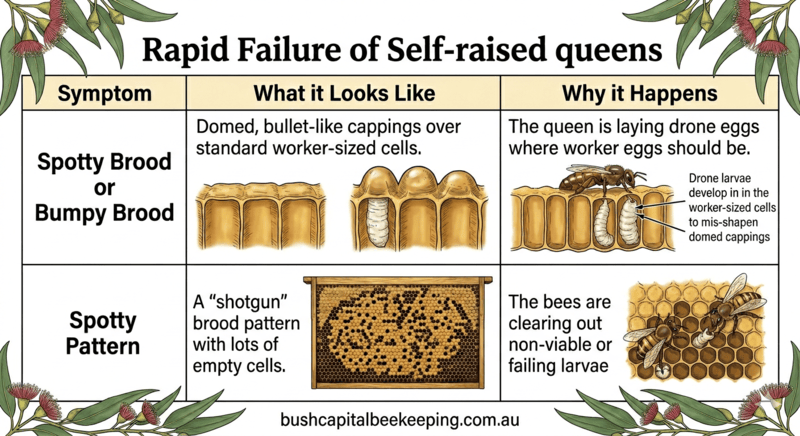
Ultimately her stored sperm will run out earlier and this could be months rather than years. Once that sperm is exhausted, she can only lay unfertilised eggs, resulting in her laying drones eggs in smaller worker cells resulting in domed or bullet shaped cappings.
This will lead to the eventual failure of the colony as workers will still sense a queen, but the workers will also be unable to self-raise a new queen due to no available viable eggs or larvae. The colonies population will dwindle until it is no longer.
The issue of Varroa Destructor is much deeper than just failing queens. The impact of Varroa on drone brood is possibly one of the most overlooked aspects of the mite’s destruction of European honeybees.
When a mite enters a drone cell, it doesn’t just steal nutrients from the developing bee, it also compromises the drone’s anatomy, reproductive capability, and adult lifespan. Some drones will never reach an age where they are sexually mature to go off and mate, let alone be fertile. With a severe lack of a vast genetic pool from feral colonies, virgin queens are now largely choosing between drones from your own yard or your immediate neighbour’s managed hives.
As such we can no longer rely on the feral done populations to properly mate our queens. If we want resilient colonies of bees in the post-Varroa era, we need to adapt our management styles, and this may mean being ruthless by culling / merging or re-queening more often.
If a self-raised queen looks sluggish or starts showing a patchy pattern early on, don’t wait for her to become a total drone layer. Combine the hive with that of a healthy productive queen, or re-queen immediately.
By understanding the pressure our Done Congregation Areas or DCAs are now under, we can take active steps to keep our colonies strong, well-mated, and productive.